Most organizations know how many laptops, monitors, and mobile devices they've purchased.
Far fewer know how many of those devices are actively creating value.
Some are sitting in storage. Some are waiting to be recovered. Others are lost in the handoff between employees, locations, and vendors.
For years, endpoint management conversations have focused on device support, security, and administration. Those remain important. But as organizations become more distributed, a new challenge has emerged:
How do you maximize the value of every endpoint throughout its lifecycle?
That's where Endpoint Value Management comes in.
Endpoint Value Management (EVM) is the practice of maximizing the business value generated by endpoint devices throughout their lifecycle.
Rather than viewing endpoints solely as hardware assets, Endpoint Value Management focuses on how devices contribute to productivity, operational efficiency, employee experience, and return on investment.
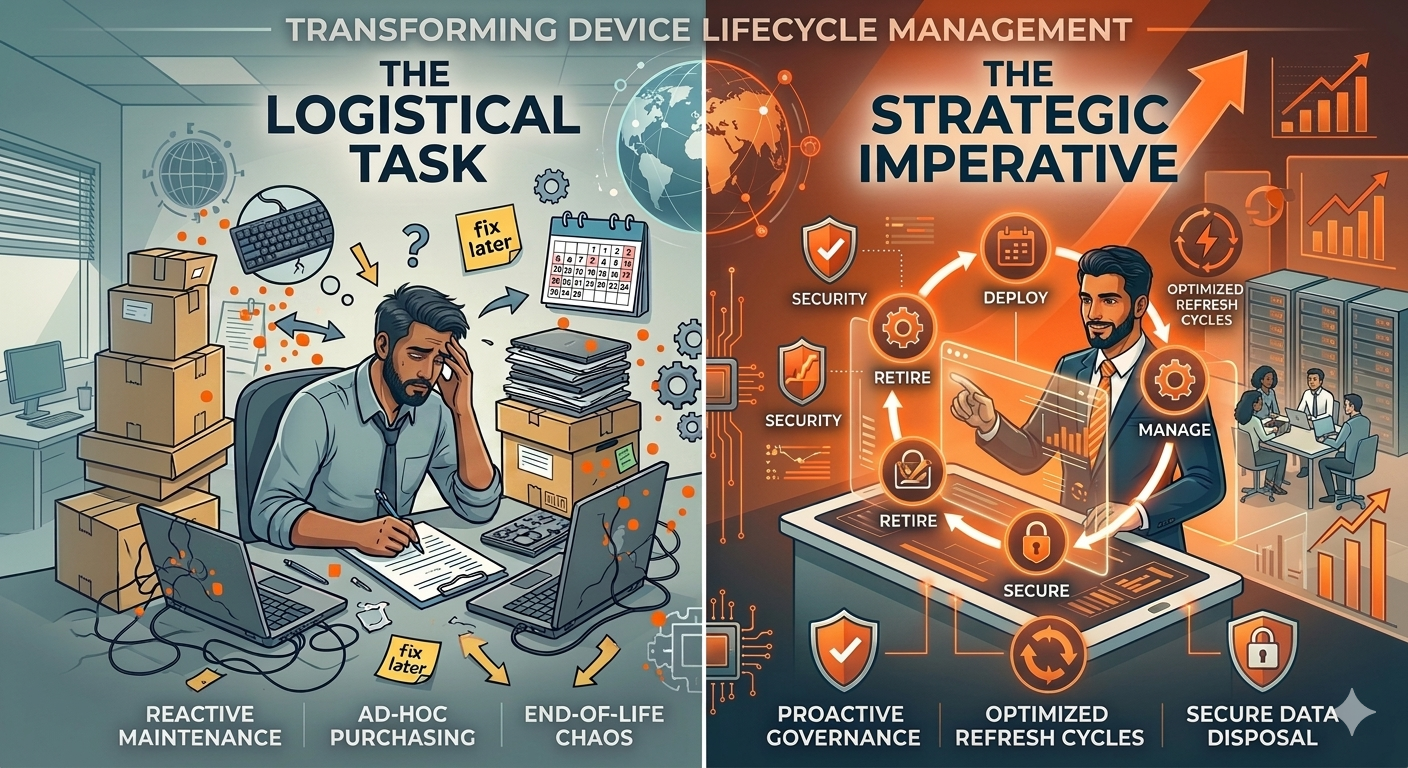
The lifecycle includes:
Every stage presents an opportunity to either create value or lose it.
The rise of remote and hybrid work has fundamentally changed how organizations manage endpoint devices.
In the past, IT teams deployed devices within centralized offices. Today, devices may be shipped across states, countries, or continents.
As endpoint estates become more distributed, common challenges emerge:
Many organizations discover they are purchasing new devices while existing inventory sits unused.
Without visibility across the endpoint lifecycle, it's difficult to make informed decisions about procurement, recovery, refresh cycles, and utilization.
Most endpoint costs never appear on a hardware invoice.
Consider a typical scenario:
A departing employee never returns a company laptop.
The replacement cost may be obvious.
Less obvious are the administrative hours spent tracking the device, updating records, coordinating recovery attempts, and replacing equipment.
Multiply that by dozens—or hundreds—of endpoints across a growing organization.
The result is often:
Visibility isn't simply an operational concern.
It's a business concern.
Traditional endpoint management focuses on keeping devices operational and secure.
Endpoint Value Management expands the conversation.
It asks questions such as:
In other words, Endpoint Value Management focuses on outcomes, not just activities.
Organizations need both approaches.
Effective device management keeps endpoints running.
Endpoint Value Management ensures those endpoints are delivering value.
Visibility forms the foundation of every successful endpoint strategy.
Organizations need accurate information about:
When visibility improves, decision-making improves.
For most employees, their endpoint device is their primary connection to work.
A delayed shipment, missing replacement device, or onboarding issue directly impacts productivity.
Organizations that prioritize lifecycle management often improve employee experiences without making significant technology investments.
Sometimes the most meaningful improvement is simply getting the right device to the right person at the right time.
Manual endpoint processes create friction.
IT teams often spend significant time coordinating:
Streamlined lifecycle operations reduce administrative burden and free IT teams to focus on strategic initiatives.
Organizations frequently focus on reducing procurement costs.
A greater opportunity may exist in improving utilization.
Recovering, refurbishing, and redeploying devices can significantly extend hardware value while reducing unnecessary purchases.
Imagine a company hiring 500 employees annually across multiple locations.
Without a lifecycle strategy, the organization experiences:
Over time, costs increase while operational complexity grows.
By implementing Endpoint Value Management principles, the company gains:
The result isn't just operational improvement.
It's measurable business value.
Asset recovery is one of the most overlooked components of endpoint lifecycle management.
When devices are not recovered after employee departures, organizations lose more than hardware.
They lose:
Strong recovery programs help organizations extend device lifecycles while reducing procurement costs.
For distributed workforces, endpoint recovery has become a critical component of overall IT asset management strategy.
Sustainability is increasingly influencing technology decisions.
Organizations are looking for ways to reduce electronic waste while maximizing the useful life of their assets.
Lifecycle-focused programs support sustainability through:
Extending device life by even a single refresh cycle can create meaningful financial and environmental benefits.
Many organizations measure endpoint activity.
Examples include:
These metrics are useful but incomplete.
Organizations should also track business outcomes, including:
These metrics provide a more complete view of endpoint performance.
As organizations continue to support remote and hybrid workforces, endpoint lifecycle management will become increasingly strategic.
The organizations that gain the most value from their endpoint investments will be those that prioritize visibility, utilization, recovery, and lifecycle optimization.
The conversation is evolving beyond simply managing devices.
The focus is shifting toward maximizing the value those devices create throughout their lifecycle.
That's the promise of Endpoint Value Management.
Endpoint Value Management is a lifecycle-focused approach that helps organizations maximize the value, utilization, and ROI of endpoint devices from deployment through retirement.
Traditional endpoint management focuses on device administration, support, and security. Endpoint Value Management focuses on the business outcomes generated throughout the endpoint lifecycle, including deployment, recovery, utilization, refurbishment, and asset optimization.
Endpoint visibility helps organizations improve inventory accuracy, reduce unnecessary purchases, strengthen governance, and maximize the value of existing assets.
Endpoint recovery enables organizations to recover assets after employee departures, improve inventory accuracy, extend device lifecycles, and reduce overall hardware spending.
Endpoint Value Management helps distributed organizations manage deployment, recovery, refurbishment, storage, and retirement processes while maintaining visibility across the entire endpoint estate.




.png)